November, 2008
Hail to
the Champions
How
do you build a playoffs-caliber ballclub? Here are eight ways.
 Allentown Ridgebacks Allentown Ridgebacks
The Ridgebacks were expected to
dominate in 2008, and despite an unexpected struggle to win their
division (a struggle in which they didn't officially capture first place
for good until the second week of September), they have done just that.
Allentown finished with 100 wins for the third time in the past seven
seasons, and their runs differential of 265 ranks second in the BDBL.
Their 921 runs scored also ranks second
among all 24 BDBL teams, and their lineup consists of no fewer than five
players who hit 25 or more home runs this season. Allentown led
the BDBL with 221 homers, and ranked #2 in batting average (.288),
on-base percentage (.360), slugging (.477) and walks (604).
On the mound, the Ridgebacks ranked #3
in the EL (#5 in the BDBL) in team ERA at 3.74. Ridgebacks
pitchers led the BDBL in strikeouts, and in fewest home runs allowed.
If there is one Achilles heel with this team, it is its defense.
The Ridgebacks owned a .982 fielding percentage this season -- good for
19th in the BDBL -- and committed 108 errors. They also allowed a
.304 batting average on balls in play -- 18th-ranked in the BDBL.
However, since adding Justin Morneau prior to Chapter Four (allowing
Ryan Braun to shift to third base), that BIP
number dropped to a more respectable .293.
The Ridgebacks went into the free agent
auction last winter with a six-man rotation already established, and a
star-studded lineup already locked in. They ranked #1 in the BDBL
in VORP (by a wide margin) before the auction began, and yet they had a whopping $39.6 million to
spend. This was made possible, in part, by a pair of trades made
by Tom DiStefano during the team's "rebuilding season" in 2007 that
netted two extremely valuable impact players, each making minimum wage.
The first trade brought Tim Lincecum
(9-12, 4.50 ERA, 156 Ks in 160 IP) to the Ridgebacks as part of an eight-player swap with the
Ravenswood Infidels in pre-season '07. In that deal, DiStefano
parted with Frank Thomas, Randy Winn, Jon Lieber and Mike Stanton, and
received Lincecum, Cliff Floyd and Mike Napoli in exchange.
The second deal was made during the
draft, when Corona GM Ed McGowan evidently suffered a temporary brain
aneurism and traded Ryan Braun (.327/.376/.595, 27 HR, 106.5 RC) to the Ridgebacks in exchange for
the impish David Eckstein and utilityman Robb Quinlan.
 Combined, Lincecum and Braun saved the
Ridgebacks perhaps as much as $34 million in market value. And
that allowed DiStefano to throw big money at Jorge Posada (.361/.434/.611,
58 2B, 25 HR, 147.5 RC) and Barry
Bonds (.255/.398/.538, 32 HR, 89.4 RC in 400 AB) in this winter's auction. Combined, Lincecum and Braun saved the
Ridgebacks perhaps as much as $34 million in market value. And
that allowed DiStefano to throw big money at Jorge Posada (.361/.434/.611,
58 2B, 25 HR, 147.5 RC) and Barry
Bonds (.255/.398/.538, 32 HR, 89.4 RC in 400 AB) in this winter's auction.
In addition to Lincecum, the Ridgebacks'
rotation
also featured three of the league's biggest bargains in Jake Peavy (24-8,
3.12 ERA, 277 Ks in 245 IP),
Felix Hernandez (9-11, 5.19 ERA in 149 IP for Allentown) and Oliver
Perez (9-6, 4.43 ERA, 184 K in 187 IP.) Peavy was acquired in DiStefano's first season at the
helm of the Ridgebacks, way back in 2002, in a trade with the Southern
Cal Slyme in which DiStefano sacrificed young slugger Vernon Wells.
Hernandez was DiStefano's #1 pick in the 2004 farm draft (#18 overall.)
And Perez was a 15th-round flier in the 2007 draft.
Of course, Hernandez has since been
flipped to the Salem Cowtippers just minutes before the final trading
deadline of the season, in exchange for �berprospect Jay Bruce and Ian
Snell (6-2, 2.63 ERA in 68+ IP for the Ridgebacks.)
As if those four pitchers -- all
earning far less than market value -- weren't enough, DiStefano had also
built up a stockpile of reserves, just for good measure. Yovani
Gallardo (6-5, 3.63 ERA in 101+ IP) was acquired in the Roy Oswalt trade with Chicago in 2007.
And Scott Baker (6-3, 3.82 ERA in 108+ IP) was added in the infamous Clay Buchholz trade of 2006.
In the 2007 draft, DiStefano added 11th
rounder Ken Griffey, Jr. (.278/.383/.546, 30 HR, 97.4 RC) and 21st-rounder Jeremy Accardo (5-1,
2.55 ERA in 74 IP).
And in Chapter Three of that year, DiStefano plucked Heath Bell (8-6,
2.00 ERA, 31 SV in 81 IP) off
of the free agent scrap heap. This winter, he signed Randy Johnson
(1-0, 2.54 ERA in 60+ IP) with the fifth pick of the free agent draft, and then (quite
brilliantly) converted him into a reliever.
The very same chapter in which he
acquired Bell as a free agent, DiStefano also picked up pitcher Jeremy
Guthrie. Thanks to the extraordinary depth in the Allentown
rotation, he was then able to flip Guthrie to the San Antonio Broncs
this winter in exchange for Aaron Rowand (.286/.340/.453, 26 HR, 99.2 RC.) DiStefano
continued to add to his arsenal throughout the summer while chasing the
Kansas Law Dogs in the division. In Chapter Four, he made five
trades, with the most significant deal being his acquisition of Morneau
(.279/.353/.452, 11 HR in 301 AB for Allentown) from the Great Lakes Sphinx in exchange for Chris Young and Napoli.
A GM's job consists of three main
tasks: trading, signing free agents and managing the farm. And
perhaps no GM in the BDBL over the past several years has done a better
job in all three areas than Tom DiStefano. The 2008 Ridgebacks are
the result of outstanding trading (Lincecum, Braun, Morneau, Rowand),
prudent use of free agency (Bonds, Posada, Griffey, Johnson, Accardo,
Bell, Guthrie), and excellent farm management (Hernandez, Buchholz,
Oswalt.) It is no coincidence that the Ridgebacks
have dominated the BDBL since DiStefano took over in 2002.
 Bear Country Jamboree Bear Country Jamboree
After nine seasons, the Bear Country
Jamboree finally captured the Griffin Division title in season ten,
going 91-69 to finish eight games ahead of the Los Altos Undertakers.
The Jamboree outscored their opponents by 141 runs -- third best in the
OL.
Offensively, Bear Country ranked third
in the entire BDBL (and first in the OL) in runs scored (888) and
on-base percentage (.348.) They ranked #4 in the BDBL in slugging
(.456) and eighth in home runs (185.) On the mound, the Jamboree
ranked right in the middle of the pack with a 4.24 team ERA. And
their 110 errors as a team ranks #1 out of the eight playoff teams this
season.
For the tenth year in a row, Alex
Rodriguez (.274/.404/.545, 43 HR, 142 runs scored, 140.7 RC) led the Bear Country offense
-- mostly batting from the leadoff spot in the lineup. The last remaining
remnant of the Bryan Sakolsky Era has just one season remaining in his
ten-year, $100 million contract.
Two members of the Bear Country lineup
were acquired in 2007: Carlos Guillen (.283/.349/.504, 72 XBH, 103.5 RC), a $9.5 million signing in
the auction, and Jose Vidro (.335/.390/.465, 96.3 RC), an 11th-round draft pick. Corey
Hart (.289/.333/.507, 90.2 RC), a mid-season farm free agent acquisition in 2002, completes
the top four hitters in the Bear Country lineup.
 On the mound, Bear Country's ace,
Brandon Webb (18-11, 3.35 ERA, 206 Ks in 249+ IP), was acquired at great cost this past winter, as GM
Matt Clemm sacrificed several young stars including John Danks, Josh
Willingham and Matt Kemp. All three were products of the Bear
Country farm system (note: Kemp was the #1 overall pick in 2006.) On the mound, Bear Country's ace,
Brandon Webb (18-11, 3.35 ERA, 206 Ks in 249+ IP), was acquired at great cost this past winter, as GM
Matt Clemm sacrificed several young stars including John Danks, Josh
Willingham and Matt Kemp. All three were products of the Bear
Country farm system (note: Kemp was the #1 overall pick in 2006.)
A.J. Burnett (15-7, 3.72 ERA, 170 Ks in
174 IP) was also acquired in trade
last winter, as part of a six-player trade with New Milford. The
key players sacrificed in that deal were also products of the Bear
Country farm system: Homer Bailey (Bear Country's second farm free agent
pick in 2004) and Jason Hirsch (a 4th-round farm pick in 2004.)
A year ago, Clemm took a $7.5 million
gamble on Tim Hudson (15-13, 4.30 ERA in 232+ IP) in the 2007 draft, and that gamble paid off,
as Hudson became a solid #3 starter for this team. And Chad Gaudin (14-10, 4.89
ERA in 191+ IP) -- who
was acquired in that infamous Sammy Sosa trade of 2004 -- completes the
Jamboree's playoffs rotation.
Historically, the Jamboree farm system
has ranked near the bottom of the BDBL. In the nine years I've
been writing the annual BDBL farm report, Bear Country has finished in
the bottom five a total of six times. But in those other three
years (2005-2007), Bear Country placed in the top twelve, and peaked
with a ranking of #3 in 2006. That year, Bear Country's farm
system included Danks, Bailey, Hirsch, Willingham and Kemp -- all of
whom were traded this past winter in exchange for players who have
carried this team to a division title.
I've said it before, and I'll say it
again: success in baseball begins and ends with the farm. The 2008
Jamboree are just another example of that.
 Chicago Black Sox Chicago Black Sox
The Chicago Black Sox captured division
title #4 this season with a record of 89-71. They ranked #5 in the
BDBL in runs scored (868) and tied at #11 in runs allowed (747.)
If you look at a graph of the history
of this franchise in terms of wins, it would look like a
perfectly-symmetrical mountain range with two-year peaks and two-year
valleys. John Gill's strategy of rebuilding, dominating,
rebuilding and dominating has served him well through the years, and his
2008 team is just the latest data point in that trend.
In 2006-2007, the Black Sox appeared to
be in the midst of another rebuilding period, as the team won 154 games
during that time. However, last year can hardly be called a
"rebuilding year," as Gill sacrificed several top prospects throughout
the year, including Fernando Martinez, Yovani Gallardo, Adam Loewen and
Chris Volstad, in an effort to win the division. In the end, he
fell five games short of that goal.
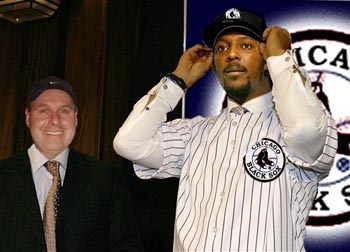 One of the players acquired in 2007 at
the expense of some of those prospects was Roy Oswalt (19-4, 3.30 ERA in
232 IP). Andruw
Jones was also added at the same time, and he was later shipped off to
Los Altos this past winter (along with Francisco Cordero) in exchange
for J.D. Drew (.264/.366/.434, 72 RC.) One of the players acquired in 2007 at
the expense of some of those prospects was Roy Oswalt (19-4, 3.30 ERA in
232 IP). Andruw
Jones was also added at the same time, and he was later shipped off to
Los Altos this past winter (along with Francisco Cordero) in exchange
for J.D. Drew (.264/.366/.434, 72 RC.)
Carlos Zambrano (13-18, 3.63 ERA in
235+ IP), acquired during
Chicago's true rebuilding year of 2006, and Jeff Francis (18-13, 4.20
ERA in 235+ IP), added in
the winter of '07, each contributed greatly to the '08 squad. And
Mark Teixeira (.324/.396/.646, 40 HR, 133.9 RC and a league-leading 135
RBIs), who was also acquired in the winter of '07, was one
of the team's top hitters this season.
Teixeira was one of three Chicago
hitters this season to post 100+ runs created. The other two --
Vladimir Guerrero (.334/.404/.558, 52 2B, 28 HR, 135.1 RC) and Placido Polanco (.354/.392/.504,
61 2B, 124 RC) -- were both acquired in
the same trade last winter from the St. Louis Apostles. Gill paid
a hefty price for those hitters, as he sacrificed Dustin Pedroia and
four others.
Also this winter, Gill signed two
players in the auction that contributed to the '08 team's success:
closer Joe Nathan (4-7, 16 SVs, 3.95 ERA in 73 IP) and inning-eater Jeff Suppan (13-10,
5.34 ERA in 215+ IP.) Joe Beimel (3-2, 4.67 ERA in 61+ IP), Juan Pierre (.294/.335/.368,
55 RC) and Melvin Mora (.295/.366/.455,
71.4 RC) were then signed with
Chicago's first three picks in the free agent draft. And in the
2007 draft, Gill took a flier on Manny Delcarmen (4-5, 21 SVs, 4.19 ERA
in 43 IP) in the 27th round.
The 2008 Black Sox are almost entirely
the product of trading. Chicago has owned one of the top ten farm
systems in the BDBL in six of the past nine years, and for the most
part, Gill has used those prospects as trade bait. With Oswalt,
Francis, Zambrano, Nathan and Teixeira all returning to Chicago next
season, and rookie Evan Longoria joining the lineup, we could very
easily see another two-year peak for this franchise.
 Corona Confederates Corona Confederates
The Confederates wrapped up the season
with a 98-62 record, and outscored their opponents by 186 runs -- the
second-highest total in the OL. In a throwback to the Marazita
Era, they were the ultimate road warriors, winning 52 games on the road
(an OL-best), while going just 46-34 at home.
Corona ranked #4 in the BDBL in runs
scored (868), despite hitting just 158 home runs (16th in the BDBL.)
They managed to do this by hitting an astounding .313/.382/.498 with
runners in scoring position.
The Corona pitching staff ranked 7th in
the BDBL in ERA (3.91), and the Corona defense allowed a balls-in-play
average of .282 -- fourth-best in the BDBL. They also turned 177
double plays -- second-best in the BDBL. And, led by Mauer, the
Confederates gunned down over 52% of would-be base stealers.
Opponents stole just 31 bases in just 65 attempts.
The biggest hitter (in more ways than
one) in the Confederates lineup arrived in the winter of 2006 through a trade
with the Chicago Black Sox. In that deal, Corona GM Ed McGowan
swapped an established, big-money superstar (Manny Ramirez) and a first
base prospect (Conor Jackson) in exchange for an established, big-money
superstar (Vladimir Guerrero) and a first base prospect (Prince
Fielder.) Fielder (.315/.417/.661, 52 HR, 154 RBIs, 161.9 RC) has since grown (in more ways than one) to
become a true BDBL superstar himself, and has carried the Corona offense
this season. He led the OL this season in slugging and RBIs, and
ranked #2 in on-base percentage and home runs.
In 2007, McGowan famously "went for it"
by signing free agent Johan Santana to a record salary in the auction.
But roughly two months later, he had a change of heart, and traded
Santana in an 11-player trade with Kansas that netted 2008 ace Aaron
Harang (14-15, 4.44 ERA in 247+ IP.) He then used the $21 million he saved by signing
Kenny Lofton (.283/.367/.442, 73.3 RC), Paul Konerko, Chone Figgins (.338/.409/.459,
94.8 RC) and Jake
Westbrook (11-6, 3.94 ERA in 164+ IP) in this year's auction. He also signed Aaron Cook
(15-6, 3.98 ERA in 183+ IP) in the auction as well. Cook was actually re-acquired, as he
was traded by the Confederates halfway through the 2007 season in
exchange for Shawn Hill (10-3, 1.87 ERA in 106 IP) and three others.
Way back in 2006, McGowan took a
16th-round gamble on third baseman Mike Lowell (.325/.363/.488, 22 HR,
110.1 RC), and that gamble has
certainly paid dividends. Roughly a year earlier, McGowan had
inherited a team that included a farm prospect by the name of Joe Mauer
(.299/.393/.431, 73.6 RC). Today, Mauer is one of the few remaining artifacts from the
Marazita Era.
 At the Chapter Four deadline this
season, McGowan acquired shortstop Edgar Renteria (.316/.383/.393 in 206
AB) to replace the
elfin David Eckstein, sacrificing Max Scherzer to do so. Corona
also received Jeff Francoeuer (.245/.286/.325 in 286 AB) and Kevin Correia (7-3,
3.97 ERA in 59 IP) in that deal. At the Chapter Four deadline this
season, McGowan acquired shortstop Edgar Renteria (.316/.383/.393 in 206
AB) to replace the
elfin David Eckstein, sacrificing Max Scherzer to do so. Corona
also received Jeff Francoeuer (.245/.286/.325 in 286 AB) and Kevin Correia (7-3,
3.97 ERA in 59 IP) in that deal.
When a consistently successful
franchise undergoes a rebuilding year, it often immediately results in a
winning season the following year. That pattern seems to have
repeated itself here with the Corona franchise. However, unlike
most patterns from the past, Corona did not benefit greatly from their
rebuilding year in terms of players received in trade or free agents
signed with the benefit of a high draft pick. Aside from Harang
and Hill, the Confederates did not receive any players in trade in 2007
that have made an enormous impact in 2008.
Instead, Corona has benefitted greatly
from spreading around their money at the auction instead of spending it
all in one place. They also benefitted from the maturation of
Prince Fielder, and the return to usefulness of Mike Lowell.
Sometimes, everything just seems to click, and the stars align in a
certain team's favor. And that has certainly been the pattern with
this franchise.
 Salem Cowtippers Salem Cowtippers
The Cowtippers finished the season
with a record of 103-57, but went just 13-15 down the stretch, and once
again find themselves limping into the post-season. Overall,
Salem's run differential of 258 ranks third in the BDBL behind the SoCal
Slyme and Allentown Ridgebacks. And their 830 runs scored ranks
sixth in the BDBL. Since the all-star break, however, the
Cowtippers have scored just 403 runs -- 9th best in the BDBL -- and they
hit just .257/.336/.435 as a team in Chapter Six.
Defensively, Salem famously came within
.001 points of breaking the BDBL's all-time single-season record for
team ERA. Their 3.26 team ERA is 27 points better than the
next-best team in the BDBL. And their 1,341 strikeouts ranks #2
behind only the Ridgebacks. Cowtipper pitchers also allowed just
134 home runs this season -- the fourth lowest total in the BDBL.
 The seeds of the current Salem starting
rotation were sewn during Salem's rebuilding season in 2006.
During that season, Salem spent $21.5 million to sign free agent
starting pitchers Randy Johnson and Kevin Millwood, with the intent to
eventually trade them for future considerations. For Johnson,
Salem received Erik Bedard (20-7, 2.83 ERA, 243 Ks in 200 IP.) For Millwood, Salem
received pitcher Jon Lester (among many others), who was (foolishly)
traded this past winter in exchange for the team's current closer,
Francisco Cordero (6-2, 1.57 ERA, 22 SVs in 68+ IP.) The seeds of the current Salem starting
rotation were sewn during Salem's rebuilding season in 2006.
During that season, Salem spent $21.5 million to sign free agent
starting pitchers Randy Johnson and Kevin Millwood, with the intent to
eventually trade them for future considerations. For Johnson,
Salem received Erik Bedard (20-7, 2.83 ERA, 243 Ks in 200 IP.) For Millwood, Salem
received pitcher Jon Lester (among many others), who was (foolishly)
traded this past winter in exchange for the team's current closer,
Francisco Cordero (6-2, 1.57 ERA, 22 SVs in 68+ IP.)
That same year, Salem took a $5 million
gamble on injured reliever Kelvim Escobar, hoping that he would
eventually move back into the starting rotation and remain healthy.
Fortunately for Salem, the stars aligned and the Baseball Gods allowed
that to happen for one season. Escobar (18-7, 3.01 ERA, 192 Ks in
215 IP) has been effective all season, and as consistent as any starter could ever be.
Also in 2006, Salem added starter Ian
Snell in a Chapter Five trade with the Corona Confederates. While
Snell's BDBL numbers for Salem (10-10, 4.96 ERA) failed to approach his stellar MLB numbers,
the acquisition of Snell allowed Salem the flexibility to trade ace
starter Brandon Webb this past winter. Webb's trade filled several
holes in the outfield, including Matt Kemp (.318/.344/.485 in 233 AB), Josh Willingham (.280/.364/.498,
74.8 RC)
and (via another foolish trade of John Danks) Mike Cameron (.321/.404/.522
in 224 AB.)
Last season, Salem took a gamble on
struggling starter Dustin McGowan (17-8, 3.46 ERA in 182+ IP), and that gamble also paid off
big-time for the Cowtippers. Salem entered the 2008 season with a
very strong starting rotation of Bedard, Escobar, Snell and McGowan.
Their intention was to add an innings-eater for the #5 spot in the
rotation, and spend $12-$14 million on a big bat in the auction.
But when they lost the bidding for all of those big bats, including
primary target Barry Bonds, the team was forced to go with "Plan B" and
spend $17 million (and a guaranteed $51M over three years) on Josh
Beckett. Beckett (13-13, 3.14 ERA, 222 Ks in 220+ IP) immediately stepped into the #1 starter role
in the rotation, and reduced Snell and/or Escobar to trade fodder.
Offensively, the team was built mostly
through recent trades, with the exceptions of farm product Kenji Johjima
(.320/.373/.462, 82.5 RC) and Cowtippers mainstay Lance Berkman (.266/.372/.457,
23 HR, 101.3 RC), playing in his final
season in a spotted cap. Derek Jeter (.322/.393/.444, 41 2B, 110.8
RC) was added in a 2006
trade involving top prospect Ian Stewart, Miguel Cabrera (.300/.360/.585,
46 HR, 130.1 RC) was
acquired mid-way through the 2007 season in a classic deal involving B.J. Upton,
and Alex Rios (.277/.326/.472, 24 HR, 89.5 RC) was added this past winter in a straight-up swap for
former franchise pitcher Jeremy Bonderman. Free agent Orlando
Hudson (.258/.321/.365, 61.7 RC) completed the starting lineup at the no-commitment-required
salary of $5M.
During the 2008 season, the Cowtippers
beefed up their lineup by trading former #1 draft pick Luke Hochevar in
exchange for Hideki Matsui (.256/.352/.431 in 371 AB.) And the bullpen was bolstered
through trade by the additions of Alan Embree (1-1, 3.31 ERA, 3 SVs in
49 IP), Matt Guerrier (1-1, 2 SVs, 2.31 ERA in 46+ IP)
and Joel Zumaya (3.38 ERA in 10+ IP.) They joined Manny Corpas (7-0,
8 SVs, 3.17 ERA in 82+ IP), a late-round
draft pick in 2007, and Aki Otsuka (2-2, 7 SVs, 2.57 ERA in 35 IP), a trade acquisition in
mid-2007.
Finally, the Cowtippers shocked the
BDBL establishment by making an 11th-hour deal with the Sith lord
himself at the final trading deadline of the season, adding Felix
Hernandez (4-4, 4.95 ERA in 60 IP) in exchange for top prospects Jay Bruce and Rick Porcello.
It is unlikely, however, that Hernandez will play a very big role in the
post-season, as Salem's four-man rotation of Beckett, Bedard, Escobar
and McGowan is rock-solid. This
year's Salem club is centered around its extraordinary starting rotation
-- a rotation that was built primarily by taking several calculated
gambles on established young pitchers. Like countless other
successful teams of the past, this team was forged during a rebuilding
year. This ballclub demonstrates that by making the right
decisions at the right times, and taking a few calculated risks,
non-contending teams have the ability to turn their fortunes upside down
and compete in a relatively short amount of time.
 Ravenswood Infidels Ravenswood Infidels
The Infidels set a new franchise record by
winning 99 games in 2008. They ranked in the middle of the pack
(10th in the BDBL) in runs scored, despite hitting just 140 home runs
(19th in the BDBL) as a team. And they ranked #4 in the BDBL in
ERA at 3.73, while allowing fewer walks than any other team in the BDBL
-- by a large margin. Defensively, the Infidels ranked 5th in the
BDBL in fewest errors, with only 88.
Most of this 2008 division championship
team was carried over from the 2007 division-winning team. Roy
Halladay (14-11, 3.46 ERA in 244+ IP), J.J. Putz (7-5, 2.41 ERA, 27 SVs
in 71 IP), Edwin Encarnacion (.306/.365/.419, 67.5 RC), Robinson Cano
(.292/.327/.498, 81 XBH, 102 RC) and Bobby Abreu (.280/.360/.456, 92.2
RC) were all instrumental in carrying the Infidels
into the OLCS last November. Of that group, Encarnacion and Cano
emerged from the Ravenswood farm system, while the rest were acquired
via trade in exchange for prospects.
 Brian Potrafka's all-time favorite player,
pitcher Fausto Carmona (17-11, 3.92 ERA in 236+ IP), was acquired in a 2006 trade with the
Nashville Funkadelic, in which the Infidels acquired both Carmona and
Jamie Moyer in exchange for Jae Seo. Moyer was then re-acquired by Potrafka this past winter during the free agent auction,
and later traded.
Also picked up in that auction were Mark Buehrle (12-10, 4.20 ERA in
216+ IP), Orlando Cabrera
(.286/.341/.370, 55.2 RC) and Bobby Howry (9-1, 2.71 ERA in 83 IP). Brian Potrafka's all-time favorite player,
pitcher Fausto Carmona (17-11, 3.92 ERA in 236+ IP), was acquired in a 2006 trade with the
Nashville Funkadelic, in which the Infidels acquired both Carmona and
Jamie Moyer in exchange for Jae Seo. Moyer was then re-acquired by Potrafka this past winter during the free agent auction,
and later traded.
Also picked up in that auction were Mark Buehrle (12-10, 4.20 ERA in
216+ IP), Orlando Cabrera
(.286/.341/.370, 55.2 RC) and Bobby Howry (9-1, 2.71 ERA in 83 IP). This
past winter, Potraka traded Frank Thomas to the Sylmar Padawans, getting
Derek Lee (.333/.411/.472, 121.9 RC) in exchange. He also added catcher Jason Varitek
(.253/.359/.420, 74.7 RC) from Salem, at the expensive cost of Jon Lester.
Throughout the course of this season,
Potrafka added to his stockpile by picking up Rodrigo Lopez (9-4, 2.60
ERA in 86+ IP), Scott
Downs (3-1, 2.70 ERA in 50 IP), Greg Maddux (8-4, 4.30 ERA in 96+ IP) and Matt Stairs (.302/.370/.544
in 215 AB). The cost was
relatively cheap: Darrell Rasner, Kerry Wood, Chris Denorfia, Rick
Vandenhurk, Jose Bautista, Jaime Garcia, Eduardo Morlan, Scott Olsen and
Jarrod Parker. This Infidels team was
constructed almost entirely through shrewd trading, which is a testament
to Potrafka's skills as a GM. Although Brian often complains about
the amount of talent he has had to sacrifice over the years, he now owns
four division titles in five seasons, plus a BDBL championship. So
it seems the reward has justified the sacrifice. And in building
this particular division-winner, Potrafka's sacrifices were hardly worth
losing any sleep. Over the past two years, Potrafka has added
Carmona, Putz, Abreu, Halladay, Luke Scott, Maddux, Stairs and Lee in
trade. And what did he sacrifice in return for this bounty of
impact players? Jae Seo, Casey Janssen, Ron Flores, Chris Carter,
Randy Winn, Freddie Lewis, Damian Easley, Brandon Phillips, Cesar
Carillo, Darrell Rasner, Kerry Wood, Chris Denorfia, Rick Vandenhurk,
Jose Bautista, Jaime Garcia, Eduardo Morlan and Frank Thomas.
Don't cry for Brian Potrafka.
 Southern Cal Slyme Southern Cal Slyme The most
dominant team in BDBL history? No, but certainly the winningest
team in league history. The Slyme began the season on fire and
never cooled off. They went 24-4 in Chapter One, 23-5 in Chapter
Six, and won 69 games in between to finish with 116 wins -- a new BDBL
single-season record. The Slyme outscored their opponents by 344
runs -- a league best. They won 64 games on the road -- also best
in the league. And they scored 954 runs -- another league-best
figure. They hit an incredible
.303/.365/.483 as a team, topping the BDBL in all three "triple-slash"
categories. SoCal pitchers posted a 3.61 team ERA -- third-best in
the BDBL. And the Slyme defense committed just 73 errors (second
lowest in the league) and posted a .988 fielding percentage.
The two biggest hitters in the SoCal
lineup were acquired in two completely different ways. Magglio
Ordonez (.374/.454/.618, 48 2B, 34 HR, 169 RC) was purchased for huge money ($14 million in 2008, and a
guaranteed $28 million over the next two years) in the free agent
auction last winter, and proved to be worth every penny. Ordonez was the #1 free agent available, and
Bob Sylvester had both the cash and the stomach to fork over
that amount to add an impact bat to his lineup.
 The other big hitter in the SoCal lineup,
Hanley Ramirez (.349/.405/.565, 62 2B, 24 HR, 34 SB, 151.9 RC), was added all the way back in the winter of 2003,
in a trade with the Marlboro Hammerheads. At the time, Ramirez was
just a 19-year-old kid kicking around in A-ball. He was acquired
along with Ichiro Suzuki in exchange for Roy Halladay, and at the time
he was considered a "throw-in" by many. But today, he's become one
of the most valuable commodities in the BDBL. The other big hitter in the SoCal lineup,
Hanley Ramirez (.349/.405/.565, 62 2B, 24 HR, 34 SB, 151.9 RC), was added all the way back in the winter of 2003,
in a trade with the Marlboro Hammerheads. At the time, Ramirez was
just a 19-year-old kid kicking around in A-ball. He was acquired
along with Ichiro Suzuki in exchange for Roy Halladay, and at the time
he was considered a "throw-in" by many. But today, he's become one
of the most valuable commodities in the BDBL.
Thanks to his infamous white-flag trades
of 2007, Sylvester had a ton of cash to spend in the auction.
Aside from Ordonez, he also purchased free agents Curt Schilling (16-3,
3.30 ERA in 160+ IP)
and Raul Ibanez (.333/.393/.600, 25 HR, 99.3 RC) -- both of whom have made bigger-than-expected
impacts on the SoCal team this season. Roger Clemens (8-3, 3.77
ERA in 90+ IP) was also
picked up in that auction, and should play a bigger role in the playoffs
than he has during the regular season.
Also added in those white-flag trades last
summer were Reggie Willits (.322/.437/.391 in 289 AB), Brad Lidge (3-0,
3.39 ERA in 61 IP), James Shields (17-9, 3.19 ERA in 223 IP) and
Ted Lilly (23-4, 3.27 ERA in 222+ IP) -- all major contributors to the '08 campaign.
In the bullpen, closer Jose Valverde (4-3,
41 SVs, 1.63 ERA in 66+ IP)
was acquired this past winter at great cost to the club's future.
Sylvester first traded Ervin Santana and Joey Devine to Atlanta for
Jesse Litsch, then flipped Litsch to his son, Bobby, in exchange for
Valverde and Ben Broussard. Later in the year, Sylvester added two
more big-impact arms to his bullpen in Hideki Okajima (2-0, 1.02 ERA in
17+ IP) and Damaso
Marte (2.92 ERA in 12+ IP). That deal cost him only two inning-eating starters for
2009, Jason Marquis and David Bush.
Waving the white flag in the middle of a
pennant race -- in a season where he eventually won the EL wild card, no
less -- only cost Bob Sylvester a little ribbing on the message board.
But the reward has far outweighed the punishment.
Waving the white flag allowed SoCal to add several impact players via
trade, and freed up several million in spending money to acquire
big-impact free agents. Many, many teams throughout BDBL history
have deliberately torpedoed a successful ballclub in order to stockpile
talent for the following year, and nearly every one of those teams has
been richly rewarded. Like it or not, the 2008 Slyme are just
another data point validating this strategy.
 St. Louis Apostles St. Louis Apostles
The Apostles eked into the post-season
during the final hours of the 2008 season, winning 98 games to finish
two ahead of the Kansas Law Dogs in the EL wild card race. Those
98 wins represent a new high for this franchise -- eight wins greater
than their previous high. Like several Eck League teams, the
Apostles performed better on the road (56-24) than at home (42-38.)
Offensively, St. Louis ranked 7th in the
BDBL in runs scored (805), 6th in slugging (.440) and 4th in stolen
bases (130.) Defensively, they ranked #6 in ERA (3.82) and #2 in
saves (53.) And, oddly enough, they also ranked #1 in the BDBL in
walks allowed (609.) Apostles pitchers averaged 3.7 walks per
nine, and struck out just 6.0 per nine on average. They also
ranked dead-last in the BDBL in throwing out base stealers, at just 17%.
In terms of how this team was built, the
foundation of this team for the past seven seasons was acquired in the
now-famous farm draft of 2001, when Bobby Sylvester selected a
relatively obscure A-ball hitter by the name of Albert Pujols with the
18th pick of the draft. Pujols (.314/.401/.539, 34 HR, 127.5 RC)
enjoyed yet another big season for the Apostles this season.
Another product of the St. Louis farm
system is Matt Holliday (.321/.378/.575, 44 2B, 35 HR, 125 RBIs, 136.2
RC), who was acquired as a free agent in Chapter Four of the 2004
season, back when he was a relatively obscure 25-year-old minor league
veteran with a career OPS of 776.
Sylvester was a busy dude this past
winter, making nine trades in an effort to keep up with his father in
the Person Division race. One of those trades netted Melky Cabrera
(.274/.330/.408, 65.7 RC) in exchange for Miguel Tejada and Chad
Cordero. Another trade netted second baseman Dustin Pedroia
(.291/.363/.447, 85.3 RC) in exchange for Vladimir Guerrero and Placido
Polanco. While both Guerrero and Polanco enjoyed MVP-caliber
seasons for the Chicago Black Sox, the Apostles gained a cheap franchise
player with that trade.
In addition to Pedroia, Sylvester also
acquired closer Jose Valverde in that same deal. He then flipped
Valverde to his father in exchange for Jesse Litsch (13-5, 3.40 ERA in
119 IP.)
At this winter's free agent auction,
Sylvester added Adrian Beltre (.264/.311/.468, 26 HR, 83.3 RC), Miguel
Batista (12-11, 4.27 ERA in 206+ IP), Tim Wakefield (16-8, 3.73 ERA in
207+ IP) and Rafael Furcal (.245/.298/.313, 46.5 RC.) Then, in the
draft, Sylvester selected Kyle Kendrick (8-5, 3.40 ERA in 132+ IP) with
his first pick in the third round.
Sylvester made just one trade after
Opening Day, but it was a big one. At the final trading deadline
of the season, he picked up Jimmy Rollins (.303/.339/.581, 37 XBH in 234
AB) from the San Antonio Broncs. And all it cost him was Andrew
Miller, Mitch Boggs, Shawn Chacon and Jamie Walker.
In my Pre-season Preview, I wrote that the
Apostles' starting rotation "may be the worst in the Eck League."
I predicted that this team would not go far in 2008 with such a mediocre
pitching staff, and picked them to finish in third place in their
division. Well...color me embarrassed. Bobby Sylvester has
created a wild-card-winning pitching staff on a shoestring budget.
The combined salaries of all the Apostles starting pitchers this season
is $15.9 million -- or, $1.1 million less than what I spent for Josh
Beckett alone.
Meanwhile, Sylvester's lineup was built
around two once-in-a-lifetime farm picks: Pujols and Holliday. One
was chosen with the 18th pick of the farm draft, and the other was
picked up off the free agent scrap heap in August. This team
represents the epitome of bargain shopping, and no one has done it
better than Bobby Sylvester. |


